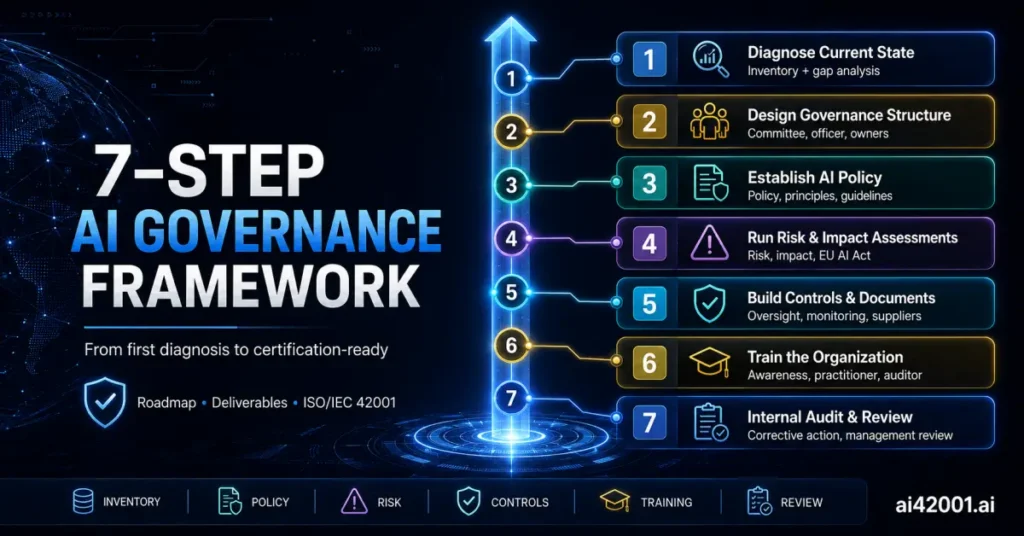
A seven-step roadmap from first diagnosis to certification-ready — with the deliverables each step should produce
Every organization that has adopted AI hits the same moment sooner or later: "We're already using AI — where does governance even start?" AI governance is not a project you complete in one push. It is built in stages, starting from an honest picture of where you are. This article lays out a practical seven-step roadmap for organizations building an AI governance framework for the first time, structured around ISO/IEC 42001 — with the deliverables each step should leave behind.
What AI governance actually is
AI governance is the sum of the policies, processes, roles, and technical measures an organization uses to develop, operate, and control AI responsibly and effectively. It is not an ethics statement on the website. It is a working operational system in which AI serves the organization's objectives, risks are controlled, and the effects on stakeholders are managed.
Built well, it delivers three things at once: risk management — preventing harm from malfunction, bias, and regulatory breach; trust — demonstrable transparency toward customers, regulators, and partners; and business value — a durable advantage that comes from being able to prove responsible operation, not just claim it.
The seven steps
Step 1 — Diagnose the current state (2–4 weeks)
The starting point is an objective picture of where AI governance stands today. Three things to establish:
- The AI system landscape — what AI runs where, for what purpose, built in-house or consumed from outside
- Existing policies worth reusing — IT security, data governance, and other documents that can anchor AI governance rather than duplicate it
- An ISO/IEC 42001 gap analysis — requirement by requirement, how far current practice falls short
A structured way to frame this diagnosis is a maturity self-assessment — our five-level, six-dimension model turns "where are we?" into scores you can act on.
Deliverables: AI system inventory; ISO 42001 gap analysis report.
Step 2 — Design the governance structure (2–3 weeks)
Governance is operated by people, and no policy survives unclear ownership. Three roles to put in place:
- An AI governance committee — chaired at executive level, with IT, legal, compliance, and business leadership at the table. It approves the AI policy, decides on high-risk AI adoption, and conducts management review.
- An AI officer — the person who coordinates day-to-day operation of the AI management system and keeps the committee's decisions moving.
- AI system owners — one per AI system, responsible for that system's risk assessment, monitoring, and escalation when something goes wrong.
Deliverables: governance organization chart; roles and responsibilities matrix (RACI).
Step 3 — Establish the AI policy and principles (2–3 weeks)
This is where direction becomes a formal, signed commitment. Three documents, in descending order of abstraction: the AI policy — the core requirement of ISO/IEC 42001 Clause 5.2, carrying the organization's commitments to fairness, transparency, accountability, safety, and privacy, signed by top management; AI ethics principles — the concrete red lines ("our AI does not do this, in any circumstances"); and staff usage guidelines — the practical rules for everyday AI use at work, including clear boundaries for generative AI tools.
Deliverables: AI policy; ethics principles; staff AI usage guidelines.
Step 4 — Run risk and impact assessments (4–6 weeks)
The most time-consuming step, and the substantive heart of the framework.
- AI risk assessment — per system, score the AI-intrinsic risks (bias, opacity, malfunction, data quality, security) by likelihood and impact, and plan treatment starting from the top. Our five-step methodology covers this end to end.
- AI impact assessment — the outward-facing half: what the system does to customers, partners, and society, with particular attention to vulnerable groups.
- EU AI Act classification — for organizations touching the EU market, place each system in the Act's risk tiers (prohibited, high-risk, limited, minimal).
Deliverables: risk assessment; impact assessments; EU AI Act classification table.
Step 5 — Build the controls and document them (6–8 weeks)
Assessment results now become operating controls:
- Human oversight mechanisms — defined points where people review and can override automated decisions; in high-stakes domains (hiring, credit, clinical support) the final decision must rest with a human
- Model monitoring — indicators and thresholds for performance degradation, bias drift, and anomalous output, on a fixed schedule
- AI supplier management — evaluation criteria, contractual requirements, and review cycles for external AI services
- Data governance linkage — training-data quality, bias detection, and privacy procedures connected to the data governance you already run
This is also where the document set an audit will examine takes shape — the ten documents a certification audit will check is the target list.
Deliverables: oversight procedures; monitoring plan; supplier management procedure; the core document set.
Step 6 — Train the organization (2–3 weeks, then recurring)
Governance is not one team's job. Three layers of training: all-staff AI awareness — the basics, the organization's policy, and the rules of use, with attendance records kept (ISO/IEC 42001 expects the evidence, not just the event); deeper training for AI practitioners — risk management, bias detection, and the standard's requirements for the people who build and operate AI; and internal auditor development — selecting and training the people who will audit the system from inside.
Deliverables: training plan; training records; internal auditor qualifications.
Step 7 — Internal audit and management review (complete ~3 months before certification)
With the system built, verify that it actually operates. Run an internal audit across all ISO/IEC 42001 requirements — our phase-by-phase checklist is built for exactly this — and put corrective actions in motion for what it finds. Then hold a management review in which top management examines the system on evidence: audit results, objective attainment, and how the risk picture has moved. Some organizations also opt for a pre-assessment by their certification body to surface gaps before the real audit; treat it as optional.
Deliverables: internal audit report; management review minutes; corrective action records.
How long the whole journey takes
Worked in sequence, the steps above take roughly nine months to a first certification audit — one month of diagnosis, a governance structure and policy by month three, assessments by month four, controls by month six, and internal audit plus management review by month nine, with the certification audit following. As a realistic range: smaller organizations with simple AI portfolios commonly land in six to nine months; large organizations with complex portfolios should plan for twelve to eighteen. These are working figures, not promises — scope and organizational complexity dominate.
One sequencing point matters more than any duration estimate: the order itself. Diagnosis before structure, structure before policy, assessment before controls. An auditor reading your document trail can usually tell whether the system was built in this order or assembled backwards from the certificate — the seams show, most visibly when controls exist that no risk assessment ever called for.
The fast path if you already hold an ISO certification
Organizations already running ISO/IEC 27001 or ISO 9001 can compress the timeline substantially, because a working management system carries over: the risk management procedure extends with AI-specific risk categories, the internal audit program takes on AI items, management review adds AI performance to its inputs, document control transfers as-is, and the competence and training framework absorbs the AI curriculum. With a well-run existing system, four to six months to certification readiness is achievable. The control-by-control route from ISO 27001 is mapped in our guide to extending an ISMS to ISO/IEC 42001.
The bottom line
Building AI governance looks daunting from the outside, and manageable from inside a sequence. The key is refusing the temptation to build a perfect system in one pass: get Step 1's diagnosis and Step 2's structure genuinely right, and the remaining steps follow from them naturally. And it is worth keeping the purpose straight — AI governance is not a means to a certificate. It is the foundation an organization needs to keep using AI in its business, sustainably and defensibly. The certificate is evidence of the foundation, not the other way round.
Step 1 starts with knowing where you stand. Our free AI governance readiness assessment takes about 10 minutes, requires no document uploads, and gives you the baseline against ISO/IEC 42001 that the rest of the roadmap builds on.
Written by a certified ISO/IEC 42001 Lead Auditor and principal consultant at ITG insights.
ITG insights specializes in ISO/IEC 42001 and ISO/IEC 20000 certification consulting, risk management, and governance framework design. Consulting and training inquiries: info@ai42001.ai
ai42001.ai is an AI governance platform structured around ISO/IEC 42001.
Related
📊 Before Step 1: the AI governance maturity model — five levels, six dimensions, and how to score yourself.
📗 The heart of Step 4: a five-step AI risk assessment methodology that holds up in an audit.
✅ Step 7 in detail: the ISO 42001 internal audit checklist, phase by phase.
🗺 The whole portfolio: part of our SC 42 AI Standards Map — the international AI standards portfolio, explained.