A certifiable standard, a binding law, and a voluntary framework — how they overlap, where they differ, and why they stack rather than compete
If you are responsible for AI governance, three names keep landing on your desk: ISO/IEC 42001, the EU AI Act, and the NIST AI Risk Management Framework. They are easy to file as "three versions of the same thing" and pick one. They are not. They sit at different layers — one is a certifiable management system, one is binding law, one is a voluntary framework — and the practical move is not to choose between them but to build one governance spine that answers to all three. This post sets out what each is, where they map onto each other, and what that means for an organization preparing for any of them.
As-of note (regulatory timelines change)
This post reflects the position as of June 2026. The EU AI Act's timeline in particular is moving: the "Digital Omnibus on AI" simplification package, politically agreed in May 2026, defers several deadlines, but takes legal effect only on formal adoption and publication in the Official Journal — anticipated around mid-2026. Treat the dates below as the agreed direction of travel, and confirm the current status against the official sources before relying on a specific date.
The one-paragraph answer
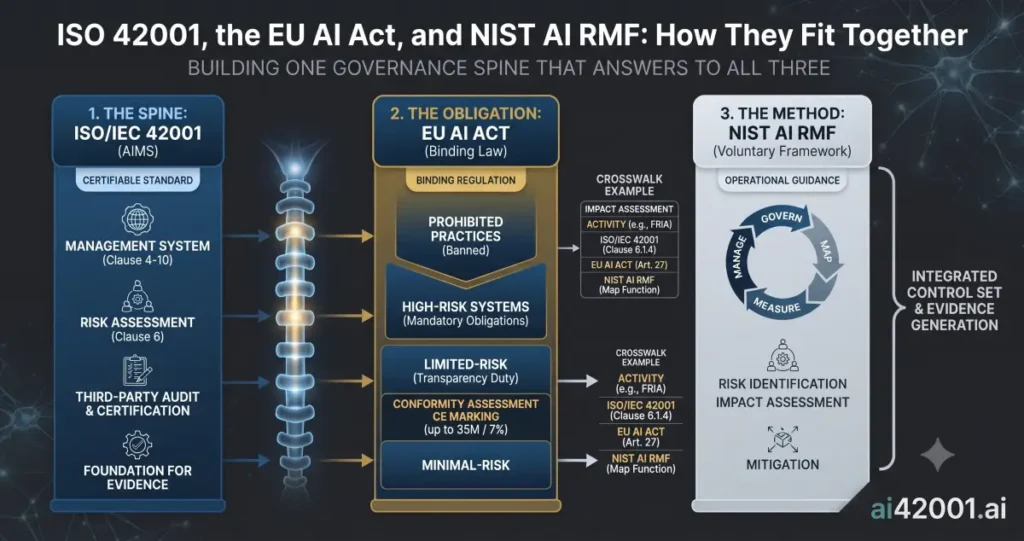
ISO/IEC 42001 is an international management-system standard you can be certified against: it specifies how to run an AI management system (AIMS). The EU AI Act is binding law with extraterritorial reach: it tells you what you must do for certain AI systems placed on or used in the EU market, with fines for non-compliance. The NIST AI Risk Management Framework is a voluntary US framework: it gives you a structured way to identify and manage AI risk, and it has become the operational layer many organizations use beneath whatever regulation applies to them. So the comparison is not "which one" — it is "how do they fit." A useful way to hold it: ISO/IEC 42001 is the spine; the EU AI Act is the obligation you must meet; NIST AI RMF is a method that helps you meet it.
| ISO/IEC 42001 | EU AI Act | NIST AI RMF | |
|---|---|---|---|
| What it is | Certifiable management-system standard (AIMS) | Binding regulation (law) | Voluntary risk-management framework |
| Legal force | Voluntary; certification is a market signal | Mandatory, with penalties | Voluntary; increasingly referenced by regulators and procurement |
| Geography | International (ISO/IEC) | EU market, extraterritorial in reach | US-origin, used globally |
| Scope trigger | Any org that develops, provides, or uses AI | Risk tier of a specific system (prohibited / high-risk / limited / minimal) | Any AI system, any sector |
| What it gives you | A governance & control system you can audit and certify | Specific obligations per risk tier | Functions and a profile structure for managing risk |
| Core structure | Clauses 4–10 + Annex A (38 controls) | Risk tiers + obligations (Articles) | Govern · Map · Measure · Manage |
ISO/IEC 42001 — the certifiable management system
Of the three, ISO/IEC 42001 is the only one an organization can be certified against by an accredited third party. It does not regulate specific AI systems; it specifies how an organization governs its AI activity as a whole — policy, roles, risk assessment, impact assessment, lifecycle controls, data governance, transparency, and continual improvement. For the full picture of what the standard requires, see the ISO/IEC 42001 reference overview.
Its value in a multi-framework world is structural. Because ISO/IEC 42001 shares the Harmonized Structure with ISO/IEC 27001 and other management-system standards, and because its controls are evidence-producing by design, it gives you a repeatable system that generates the documentation the other two frameworks ask to see. It is the place to build the spine.
The EU AI Act — binding law, by risk tier
The EU AI Act (Regulation (EU) 2024/1689) is the world's first comprehensive horizontal AI law. It entered into force on 1 August 2024 and applies in phases. Crucially, it is risk-tiered: obligations attach to a system's risk classification, not to AI in general.
- Prohibited practices (for example social scoring, certain manipulative or biometric uses) — banned since 2 February 2025.
- High-risk systems (Annex III standalone systems such as recruitment, credit scoring, education, and law-enforcement tools; and Annex I product-embedded systems) — the heaviest obligations: risk management, data governance, technical documentation, logging, transparency, human oversight, accuracy and robustness.
- Limited-risk systems — transparency duties, such as disclosing that a user is interacting with an AI system or that content is AI-generated.
- Minimal-risk systems — the vast majority; no specific obligations.
Two things make it impossible to ignore from outside the EU. First, like the GDPR it is extraterritorial: it can apply to providers and deployers outside the EU whose systems are placed on the EU market or whose output is used in the EU. Second, the penalties are large — up to €35 million or 7% of global turnover for prohibited practices, and up to €15 million or 3% for high-risk non-compliance.
The 2026 timeline shift (Digital Omnibus)
Through 2025, implementation ran behind — national authorities and harmonized standards were not ready — and in November 2025 the Commission proposed the "Digital Omnibus on AI" to simplify and defer parts of the Act. As of June 2026 the agreed changes (pending formal adoption) are:
- High-risk Annex III (standalone) obligations deferred from 2 August 2026 to 2 December 2027 — roughly sixteen extra months.
- High-risk Annex I (product-embedded) obligations deferred to 2 August 2028.
- Synthetic-content marking (Article 50(2) watermarking) deferred to 2 December 2026.
- Two new prohibitions — AI "nudifier" tools and AI-generated CSAM — added to Article 5, effective 2 December 2026.
What did not move: the prohibited-practices ban (since February 2025) and the general-purpose AI (GPAI) obligations (since August 2025) are already in force and unchanged, and the GPAI enforcement powers activate in August 2026. The broader Article 50 duty to tell people they are interacting with an AI system also proceeds on the original schedule. So the deferral buys time on the high-risk wave — it does not switch the Act off. And because these dates take legal effect only on publication in the Official Journal, the prudent stance is to keep preparing rather than bank on the extension.
NIST AI RMF — the voluntary operational layer
The NIST AI Risk Management Framework (AI RMF 1.0, formally NIST AI 100-1, published January 2023) is a voluntary, technology-agnostic, sector-neutral framework built around four functions — Govern, Map, Measure, Manage. It does not certify anyone and carries no penalties. Its influence comes from adoption: it has become, for many organizations, the operational method they use to do AI risk management, including as preparation for the EU AI Act.
The framework has grown into an ecosystem. The Generative AI Profile (NIST AI 600-1, July 2024) adds twelve GenAI-specific risk categories — confabulation, data privacy, harmful bias, information integrity, and others — mapped back onto the four functions, so organizations layer it on top of what they already have rather than starting over. As of mid-2026, AI RMF 1.0 is being revised (no formal "2.0" yet), with further profiles and addenda in progress — a preliminary Cyber AI Profile (NIST IR 8596, draft December 2025), a Critical Infrastructure profile concept note (April 2026), and an AI Agent Standards Initiative launched through NIST's CAISI in early 2026.
For this discussion the most useful fact is that NIST has published an official crosswalk mapping AI RMF subcategories to ISO/IEC 42001 clauses. The two were designed to coexist: NIST itself treats work done for one as contributing to the other.
How they fit together — one spine, two plug-ins
Set side by side, the three frameworks ask for strikingly similar artifacts under different names. That is the opportunity: design each control once, in the ISO/IEC 42001 management system, and map its output to the EU AI Act article and the NIST function it satisfies. A representative mapping:
| The activity | ISO/IEC 42001 | EU AI Act (high-risk) | NIST AI RMF |
|---|---|---|---|
| Governance & accountability | Clause 5, A.2, A.3 (and ISO/IEC 38507) | Deployer duties (Art. 26) | Govern |
| Risk management | 6.1.2, 6.1.3 (and ISO/IEC 23894) | Risk management system (Art. 9) | Map · Measure · Manage |
| Impact on people & society | 6.1.4, A.5 (and ISO/IEC 42005) | Fundamental Rights Impact Assessment (Art. 27) | Map |
| Data governance | A.7 | Data and data governance (Art. 10) | Map · Measure |
| Technical documentation | A.6.2.7 | Technical documentation (Art. 11, Annex IV) | Govern · Manage |
| Record-keeping / logging | A.6.2.8 | Logging (Art. 12) | Measure |
| Transparency to users | A.8 | Transparency (Art. 13, Art. 50) | Govern |
| Human oversight | A.9 | Human oversight (Art. 14) | Govern · Manage |
| Accuracy, robustness, security | A.6.2.4 (and ISO/IEC 23053) | Accuracy, robustness, cybersecurity (Art. 15) | Measure |
| Post-market monitoring | A.6.2.6, Clauses 9–10 | Post-market monitoring (Art. 72) | Manage |
The pattern is hard to miss: an organization with a working ISO/IEC 42001 management system has already produced most of the evidence the other two frameworks ask for. The impact assessment you build for A.5 and Clause 6.1.4 is the same artifact, in structure, as the EU AI Act's FRIA and the "Map" work in NIST — which is exactly why the ISO/IEC 42005 impact-assessment guidance is worth designing once and reusing across all three.
So does ISO/IEC 42001 certification mean EU AI Act compliance?
No — and this is the distinction to be careful about. Certification to ISO/IEC 42001 does not, by itself, equal compliance with the EU AI Act. The Act has specific legal requirements (conformity assessment, CE marking and EU database registration for certain high-risk systems, defined reporting obligations) that a management-system certificate does not discharge. A standard is a voluntary system; a regulation is law.
What ISO/IEC 42001 does give you is the management-system spine that makes meeting the Act far more achievable: the governance, risk, impact-assessment, data, transparency, and oversight machinery the Act assumes you have. Harmonized European standards (under development) are expected to provide the formal presumption-of-conformity route for the Act; until and alongside those, an AIMS built to ISO/IEC 42001 is the most transferable foundation, and NIST AI RMF is a well-mapped method for operating it. The efficient design goal is one integrated control set, mapped outward — not three parallel programs.
From an advisory perspective — design once, map to many
(These are practical observations, not assertions about any specific organization.)
- Start from the management system, not the regulation. Building to the EU AI Act article-by-article tends to produce a compliance file for one jurisdiction. Building the ISO/IEC 42001 system first produces a spine that the Act, NIST, and the next regulation all plug into.
- Make the impact assessment the shared asset. The single artifact that does the most cross-framework work is the AI system impact assessment — it answers ISO/IEC 42001 A.5, the EU AI Act FRIA, and NIST's Map function at once. Design it to satisfy the strictest of the three.
- Keep a live mapping table. A maintained ISO 42001 ↔ EU AI Act ↔ NIST crosswalk (NIST's own ISO 42001 crosswalk is a starting point) turns "we comply with three frameworks" from three audits into one evidence set viewed three ways.
- Watch the dates, but don't pause. The Digital Omnibus deferral is real, but it is a timing change to one wave, not a reprieve — and it is not yet formally adopted. Organizations that keep building through the extension will be the ready ones.
To see where the underlying standards sit, the ISO/IEC AI Standards Map lays out the SC 42 portfolio on a single page.
The bottom line
ISO/IEC 42001, the EU AI Act, and NIST AI RMF are not competitors and not substitutes. They are a standard, a law, and a method — three layers of the same problem. The EU AI Act says what you must achieve for certain systems; NIST AI RMF offers a structured way to achieve it; ISO/IEC 42001 gives you the certifiable management system that holds all of it together and produces the evidence. For an organization facing more than one of them — which, with the Act's extraterritorial reach, is most organizations using AI at any scale — the winning move is to build the ISO/IEC 42001 spine once and map it outward, rather than running three programs in parallel.
Written by a certified ISO/IEC 42001 Lead Auditor and principal consultant at ITG insights.
ITG insights specializes in ISO/IEC 42001 and ISO/IEC 20000 certification consulting, risk management, and governance framework design. Consulting and training inquiries: info@ai42001.ai
ai42001.ai is an AI governance platform structured around ISO/IEC 42001.
Related
📘 The standard itself: the ISO/IEC 42001 reference overview, and how to extend an ISO 27001 ISMS to ISO 42001.
🧭 The shared asset: ISO/IEC 42005 — AI system impact assessment (the FRIA / NIST-Map counterpart), and ISO/IEC 23894 — AI risk management.
🏛 The governance layer: ISO/IEC 38507 — governance of the use of AI.
🗺 The whole portfolio: the ISO/IEC AI Standards Map.